Speaking is a better way to think and a worse way to write
People speak around three times faster than they type, and think faster than either. That gap is why dictation is appealing. It is also why raw dictation makes such poor prompts: the extra throughput is spent on material you would have edited out.
The trade you are actually making
Typing is slow enough to be a filter. You drop the false start, reorder the sentence, delete the aside — not deliberately, just because the delay gives you room to. Speaking removes the delay and the filter with it. You get more of what you meant, in a worse shape:
- Self-corrections left in.“Move it to Tuesday, no, Thursday” — with both days still in the text, and a model that has to guess which one you meant.
- Order that follows recall, not logic. The constraint arrives last because you remembered it last.
- No structure at all. Speech has no headings. Goal, context and constraint come out as one breath.
- Filler. Harmless in a meeting, noise in a brief.
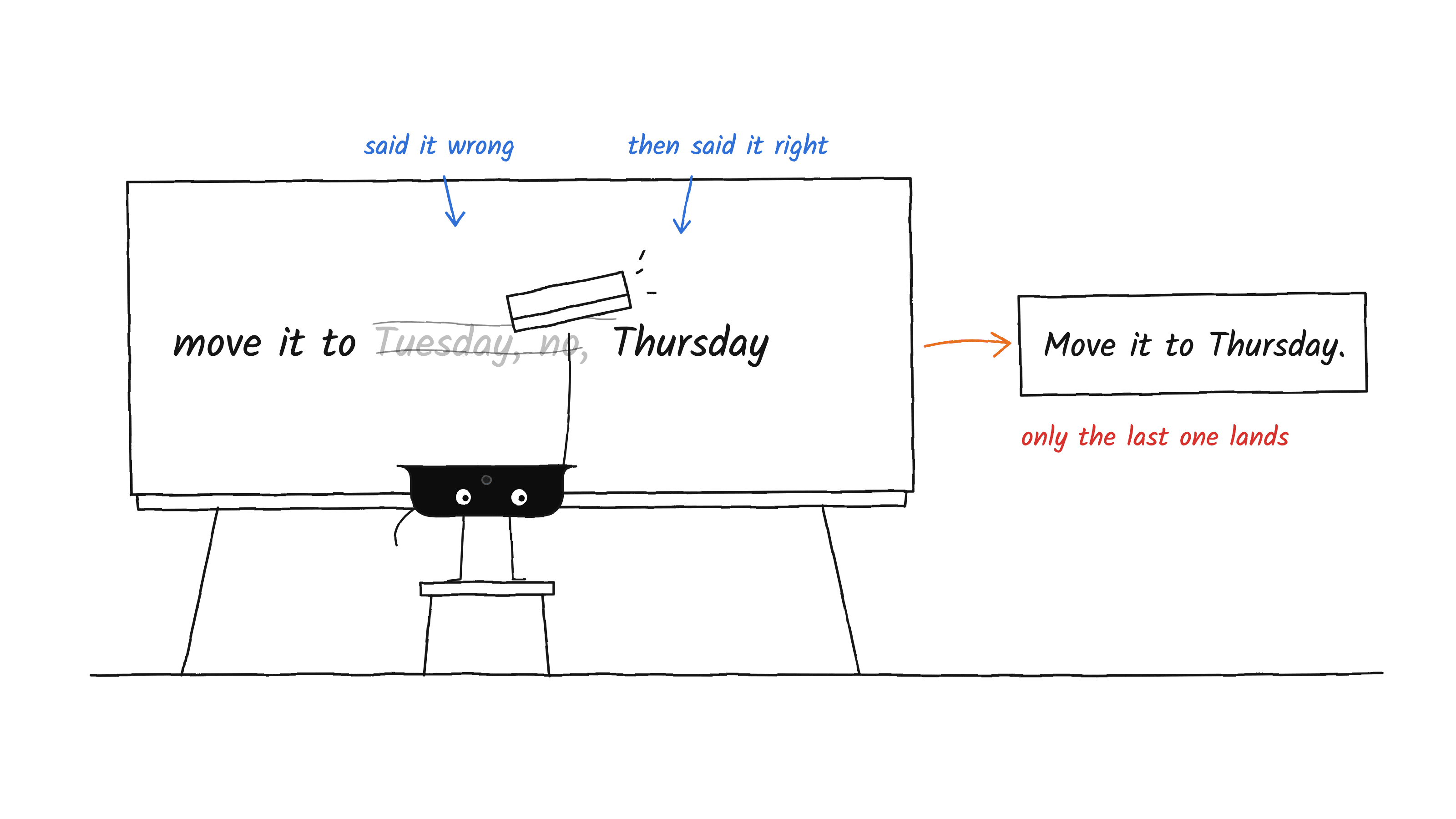
Speaking is a better way to get it out of your head and a worse way to put it on the page. Both halves are true and only one of them is a problem you can fix.
What has to happen to the words
A dictation tool that only transcribes hands you the raw material and leaves the second half of the job with you. Four things have to happen to a spoken request before it is a prompt:
um so the sidebar thing, it should collapse, actually no — it should stay open on desktop and collapse on mobile, and don’t change the header, I already did that
## Goal
Make the sidebar responsive.
## Tasks
1. Keep it open on desktop.
2. Collapse it on mobile.
## Constraints
Don’t change the header — already done.
The retraction resolved to one answer. The filler gone. The constraint promoted out of the tail of a sentence into its own section. And crucially, nothing dropped: “I already did that” survives as the reason, because it is the part that stops the agent redoing it.
The part that must not be automated
There is a line here worth being careful about. Restructuring what you said is useful. Inventing what you did not say is not — and it is the failure mode every tool in this category has to be judged on, because it is invisible. A summary that reads well and quietly dropped one of your constraints looks exactly like a good one until an agent acts on it.
The rule Yappr holds itself to: every detail you spoke survives, and nothing arrives that you did not say. A one-sentence brief produces a short prompt. That is correct, not incomplete.
Talking as thinking
The underrated part is not speed. It is that describing a problem out loud is a genuinely different cognitive act from typing it — closer to explaining it to somebody. You find the gap in your own reasoning halfway through the sentence, which is the same reason rubber-duck debugging works.
That is worth keeping. It just needs something to do the filing afterwards, so the thinking-out-loud version and the version you send are not the same document.